Two weeks ago, on December 7, I received an email to my gmail account telling me that I received a $25 gift certificate to iTunes from ?. I suspected that it was spam and was also enundated with emails at the time and didn't examine it further. But a week later I remembered it, brought it up, and it seemed legit--the email was from apple.com. I decided to open it at work in case it contained a virus, but there were no attachments, just links, and it worked through iTunes. So now I have a $25 credit and have no idea who (from whom?) it's from. Is it from someone I know? They had to have had my email address to give it to me, I think. Was it just a random act of kindness? Will someone step forward to claim responsibility at a later date? Was it an early Christmas present?
At any rate, if the anonymous donor is reading this, thank you very much for your generous gift, I greatly appreciate it. I haven't yet purchased any new songs, but I hope to soon.
And the second thing is my friend Chris wrote this article about hipster parents and musical taste that I liked. And yes, the picture bears a remarkable resemblance to him.
Showing posts with label article. Show all posts
Showing posts with label article. Show all posts
Tuesday, December 19, 2006

Monday, October 30, 2006
Ants on stilts
Great name for a children's book, eh? Maybe a sequel to Whales on Stilts?
On Saturday night while on the bus on my way to a Halloween party, I was listening to old NPR podcasts from July, and heard the craziest thing (I'm once again coming into amazing news late, so forgive me if you've heard this before).
German scientists were studying the navigational abilities of Desert Ants, and had the theory that ants somehow counted their strides to navigate. To prove this theory, they cut the ants' legs so that their stride was shorter. They found that the ants came up short of their home. So then they tested the ants by making stilts for their legs to make their strides longer. To do this, they glued hog hairs onto each leg of the ant. Sure enough, the ants with stilts were overshooting their home. Therefore, they determined that these ants somehow counted the steps they were taking to find their ways home--they have some sort of internal counting-mechanism! Isn't that crazy?
The original study was printed in Science Magazine, but the language there is so full of science mumbo-jumbo; the articles on Seed Magazine and The Economist are much easier. This is the final paragraph from the latter:
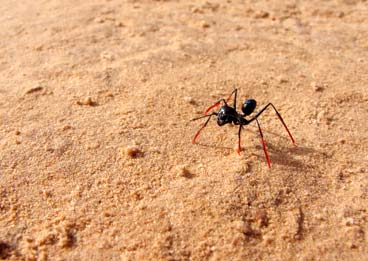 Kinda scary looking, actually.
On Saturday night while on the bus on my way to a Halloween party, I was listening to old NPR podcasts from July, and heard the craziest thing (I'm once again coming into amazing news late, so forgive me if you've heard this before).
German scientists were studying the navigational abilities of Desert Ants, and had the theory that ants somehow counted their strides to navigate. To prove this theory, they cut the ants' legs so that their stride was shorter. They found that the ants came up short of their home. So then they tested the ants by making stilts for their legs to make their strides longer. To do this, they glued hog hairs onto each leg of the ant. Sure enough, the ants with stilts were overshooting their home. Therefore, they determined that these ants somehow counted the steps they were taking to find their ways home--they have some sort of internal counting-mechanism! Isn't that crazy?
The original study was printed in Science Magazine, but the language there is so full of science mumbo-jumbo; the articles on Seed Magazine and The Economist are much easier. This is the final paragraph from the latter:
The story, however, has a happy ending. Having proved his point, Dr Wittlinger returned both stumped and stilted ants to the nest and gave them a few days to recover. Then he let them out for another run. Now that they could re-count their outbound journeys, they were able to calculate the journey home correctly. Ants may not be very bright, but it seems they have a head for figures.And check out this picture--an ant on stilts!
 Kinda scary looking, actually.
Thursday, October 19, 2006
Autism linked to television watching?
I listened to this Slate.com podcast on the way to work this morning and was pretty amazed. Who knows if this is true, but I wonder if there will be any ramifications in the children's television world.
Read more children's books, I say!
Also, I'd like to direct all of you over to the Blue Rose Girls site for our first-ever Cupcake Contest! Cast your vote now, and enter to win CUPCAKES!! Yes, cupcakes. Well, or a cupcake-related prize.
Read more children's books, I say!
Also, I'd like to direct all of you over to the Blue Rose Girls site for our first-ever Cupcake Contest! Cast your vote now, and enter to win CUPCAKES!! Yes, cupcakes. Well, or a cupcake-related prize.
Thursday, September 14, 2006
Wednesday, August 30, 2006
Do you know your own mind?
In a previous post, I talked about racism, and mentioned the book Blink by Malcolm Gladwell. This book explores how we think without thinking--in the blink of an eye. How our instinct oftentimes take into account our lifetime of experience. He talks about a psychologist who can predict with 95% accuracy if a couple is going to end up together 15 years from now after watching a tape of them interacting for an hour, and 90% accuracy after just 15 minutes. He describes the tennis coach who knows when a player will double fault before the racket hits the ball. And part of the reason why they can do this (they weren't born with this skill) is that they have become experts, with experience and training, their minds have been honed to do this. Although I'm not sure if I can really call myself a children's book expert, I think if I'm an expert in anything, that's it. And in my job, I often know if I'm going to turn down a manuscript after reading one sentence, (Of course I read more than that just in case!), and it comes from reading so many books and manuscripts and knowing what I like and what I don't.
Well, Gladwell also explores when perhaps we shouldn't trust our instincts, and one situation is when racism or preconceptions come into play. He talks about this test, which I had coincidentally taken before reading the book, because a friend had forwarded it to me. It's completely fascinating, so I highly recommend checking this website out and taking a few tests: https://implicit.harvard.edu/implicit/
This is how the tests are described on the site:
It is well known that people don't always 'speak their minds', and it is suspected that people don't always 'know their minds'. Understanding such divergences is important to scientific psychology.
This web site presents a method that demonstrates the conscious-unconscious divergences much more convincingly than has been possible with previous methods. This new method is called the Implicit Association Test, or IAT for short.
According to Gladwell, over 80% of people taking the Race IAT end up having pro-white associations. Even Gladwell himself showed a "moderate automatic preference for whites"--and he himself is half black! I showed a preference for whites as well after taking the test, and considering I'm a minority myself, I don't consider myself racist (although since I've taken these tests before, I know that everyone is, a little bit...).
Gladwell says, "The disturbing thing about the test is that it shows that our unconscious attitudes may be utterly incompatible with our stated conscious values...of the fifty thousand African Americans who have taken the Race IAT so far, about half of them, like me, have stronger associations with whites than with blacks. How could we not? We live in North America, where we are surrounded every day by cultural messages linking white with good." (p. 85)
But what I found MOST amazing (and please bear with me, I know this is long, but thanks for reading this far!), what I found most affirming and hopeful was this section of one paragraph:
"...believe it or not, if, before you take the IAT, I were to ask you to look over a series of pictures of articles about people like Martin Luther King or Nelson Mandela or Colin Powell, your reaction time would change. Suddenly it won't seem so hard to associate positive things with black people. 'I had a student who used to take the IAT every day' Banaji says, 'It was the first thing he did, and his idea was just to let the data gather as he went. Then this one day, he got a positive association with blacks. And he said, 'That's odd. I've never gotten that before,' because we've all tried to change our IAT score and couldn't. But he's a track-and-field guy, and what he realized is that he'd spent the morning watching the Olympics.'"
I found this hopeful and affirming because one of my goals of being in publishing is to make sure that minorities and other unrepresented groups are featured more in children's books, because I know from personal experience that it really troubled me as a child to not see characters that looked like me in the books I was reading (let alone magazines, television, and movies). I was so thirsty for characters that were like me that whenever a character had black hair, I would think hopefully, "Maybe she's Asian!"--I even wanted Snow White to be Asian. And I think this is also partially why I loved the Emily books by L.M. Montgomery more than the Anne books (although of course I loved those, too!)--because Emily had black hair. This is normal--we all know that kids want to see themselves in the books their reading. That's why we buy books like Eloise for little girls named Eloise, and Fancy Nancy for girls named Nancy (alas, not Alvinas in any of the books I was reading, either! Although as an adult I did find a D.H. Lawrence book The Lost Girl with an Alvina in it and of course read it even though it was not very good).
And especially for minority kids growing up in mostly white communities, the positive "examples" of people who look like them are even less. And when white children aren't seeing any kinds of depictions of kids of other ethnicities either, that's problematic as well. I often realized that I was oftentimes the only example of an Asian person that some people ever met, and I certainly don't think I'm a great representative of my ethnicity!
So, to have this confirmation that seeing positive, diverse images in children's books can make a psychological difference, a subconscious difference, to lessen the bias against people of color, well, this was so affirming for me. It is important. It does make a difference.
Take the tests here, see how you do.
Well, Gladwell also explores when perhaps we shouldn't trust our instincts, and one situation is when racism or preconceptions come into play. He talks about this test, which I had coincidentally taken before reading the book, because a friend had forwarded it to me. It's completely fascinating, so I highly recommend checking this website out and taking a few tests: https://implicit.harvard.edu/implicit/
This is how the tests are described on the site:
It is well known that people don't always 'speak their minds', and it is suspected that people don't always 'know their minds'. Understanding such divergences is important to scientific psychology.
This web site presents a method that demonstrates the conscious-unconscious divergences much more convincingly than has been possible with previous methods. This new method is called the Implicit Association Test, or IAT for short.
According to Gladwell, over 80% of people taking the Race IAT end up having pro-white associations. Even Gladwell himself showed a "moderate automatic preference for whites"--and he himself is half black! I showed a preference for whites as well after taking the test, and considering I'm a minority myself, I don't consider myself racist (although since I've taken these tests before, I know that everyone is, a little bit...).
Gladwell says, "The disturbing thing about the test is that it shows that our unconscious attitudes may be utterly incompatible with our stated conscious values...of the fifty thousand African Americans who have taken the Race IAT so far, about half of them, like me, have stronger associations with whites than with blacks. How could we not? We live in North America, where we are surrounded every day by cultural messages linking white with good." (p. 85)
But what I found MOST amazing (and please bear with me, I know this is long, but thanks for reading this far!), what I found most affirming and hopeful was this section of one paragraph:
"...believe it or not, if, before you take the IAT, I were to ask you to look over a series of pictures of articles about people like Martin Luther King or Nelson Mandela or Colin Powell, your reaction time would change. Suddenly it won't seem so hard to associate positive things with black people. 'I had a student who used to take the IAT every day' Banaji says, 'It was the first thing he did, and his idea was just to let the data gather as he went. Then this one day, he got a positive association with blacks. And he said, 'That's odd. I've never gotten that before,' because we've all tried to change our IAT score and couldn't. But he's a track-and-field guy, and what he realized is that he'd spent the morning watching the Olympics.'"
I found this hopeful and affirming because one of my goals of being in publishing is to make sure that minorities and other unrepresented groups are featured more in children's books, because I know from personal experience that it really troubled me as a child to not see characters that looked like me in the books I was reading (let alone magazines, television, and movies). I was so thirsty for characters that were like me that whenever a character had black hair, I would think hopefully, "Maybe she's Asian!"--I even wanted Snow White to be Asian. And I think this is also partially why I loved the Emily books by L.M. Montgomery more than the Anne books (although of course I loved those, too!)--because Emily had black hair. This is normal--we all know that kids want to see themselves in the books their reading. That's why we buy books like Eloise for little girls named Eloise, and Fancy Nancy for girls named Nancy (alas, not Alvinas in any of the books I was reading, either! Although as an adult I did find a D.H. Lawrence book The Lost Girl with an Alvina in it and of course read it even though it was not very good).
And especially for minority kids growing up in mostly white communities, the positive "examples" of people who look like them are even less. And when white children aren't seeing any kinds of depictions of kids of other ethnicities either, that's problematic as well. I often realized that I was oftentimes the only example of an Asian person that some people ever met, and I certainly don't think I'm a great representative of my ethnicity!
So, to have this confirmation that seeing positive, diverse images in children's books can make a psychological difference, a subconscious difference, to lessen the bias against people of color, well, this was so affirming for me. It is important. It does make a difference.
Take the tests here, see how you do.
Subscribe to:
Posts (Atom)